
The power of connection. When instruments begin to shape one another.
Connect the parameters, Motion Waves and musical behaviours of entirely different synthesis engines, so one instrument can change how another sounds, moves and responds.
Select any parameter or Motion Wave and connect it to another parameter, wave, instrument or musical behaviour. Shape the relationship’s amount, direction, timing and response, and hear it as you make it. Keep a useful group of relationships as a behaviour to reuse. Deeper routing is there when you need it, without a giant modulation matrix to manage.
A living musical system.
Five stars and the relationships between them. Pick one to follow it.
Example system
Play, influence and reshape the whole system through a few meaningful controls. When it’s complete, it can become an editable instrument inside another.
Six kinds of connection.
Each can join entirely different engines.
Parameter to parameter
A filter’s movement in one star can set the FM depth in another.
Motion Wave to Motion Wave
One wave can speed up, deepen or reshape another.
Sound to sound
A sampled strike sets a physical model ringing, or an oscillator modulates another engine at audio rate.
Rhythm to synthesis
Percussion accents trigger other instruments or change their timbre.
Harmony to movement
A chord change can reshape Motion Waves, rhythms and the sound itself.
Instrument to instrument
Whole instruments trigger, modulate and respond to one another.
Effects can become instruments.
The same effects as every star, connectable across instruments.
The Plasma Star to Shimmering reverb to The Particle Star to Rhythmic gate to A playable instrument
Place an effect between instruments, share one between several or let it feed another engine. Here, a Motion Wave moves the reverb’s decay, The Particle Star turns the reverb’s tail into grains and The Kinetic Star’s beat opens and closes the gate. You play it all as one instrument.
Explore StarShaper
Back to StarShaper-
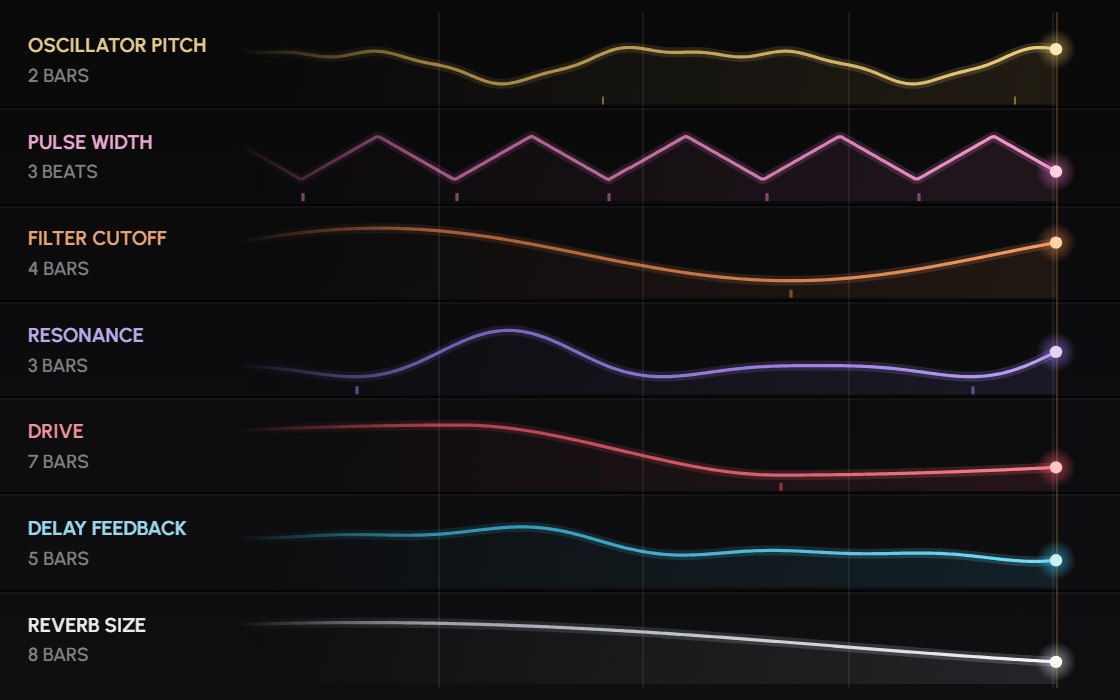
How does it move?
Motion Waves
Every supported parameter can move in its own time, and in StarShaper one instrument’s movement can shape another’s.
-
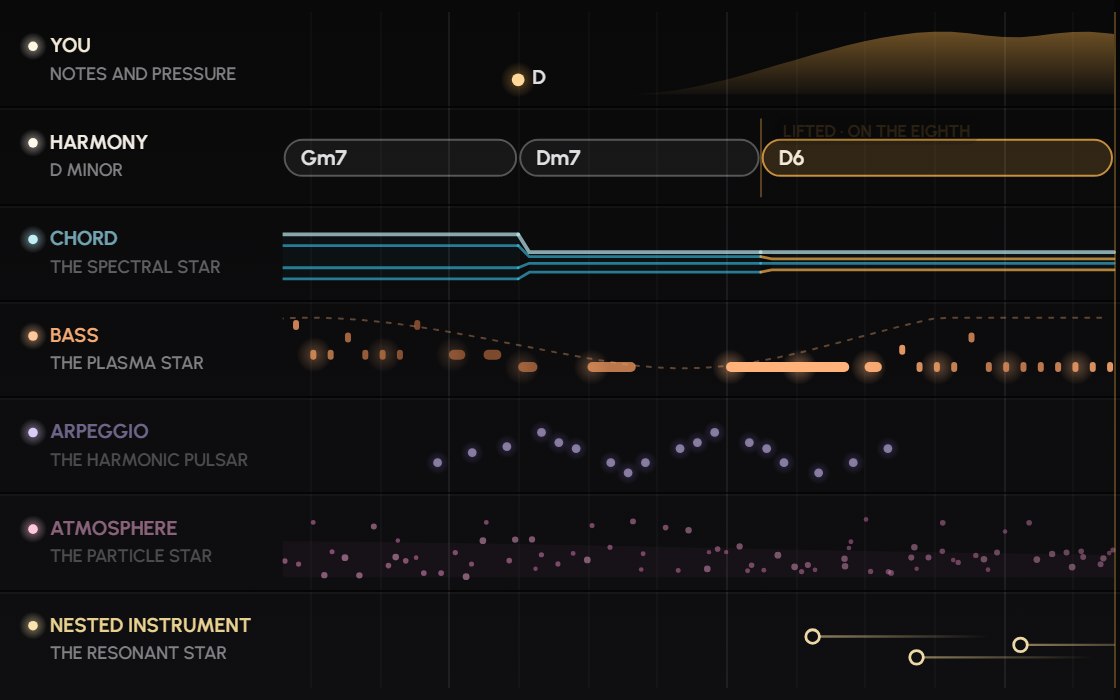
What does it play, and when?
Intelligent musical creation
Harmony, rhythm, arpeggiation, arrangement and performance become connected parts of the instrument, shared across everything you bring together.
-
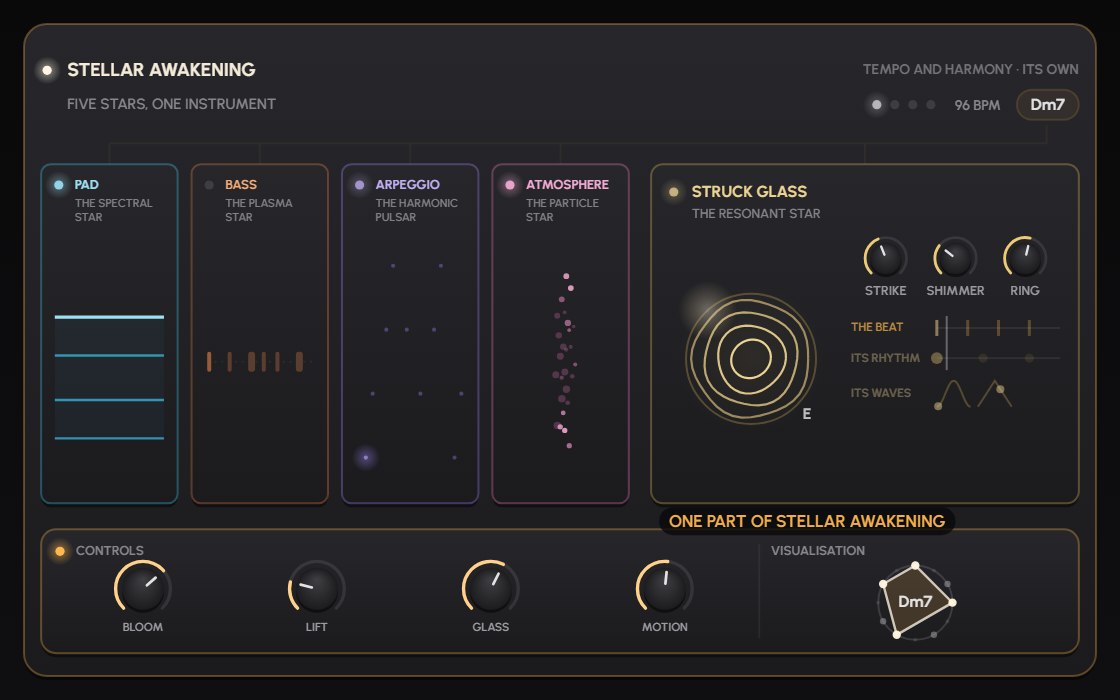
What can it become?
Instruments within instruments
Everything you build, its musical behaviour and connections included, can become an editable part of something larger.